• Skip to primary navigation
  • Skip to main content
Hostetler Public Relations

Hostetler Public Relations

Providing public relations and marketing communications counsel, strategy and support

  • About
  • Services
  • Clients
  • Partners
  • Of Interest
  • Blog
  • Contact

Rae Hostetler

Know the P in your PR plan

Rae Hostetler · Jun 3, 2026 ·

Public relations is about telling the people (your publics) who you’re trying to educate, influence, sell to and engage about who you are and what you do. That’s why it’s important to understand the people (the P) in your PR plan. How people research, decide and spend their money and time is different depending on their age.

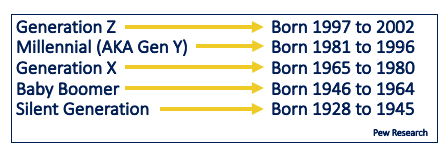
In January, Pew released a study on Millennials. That prompted me to do some research about myself (Gen X) and others. Here’s what the researchers have to say.

Generation Z: Born 1997 to 2002

  • This group is late middle school, high school to college aged.
  • My children are Generation Z.
  • They think visually. They grew up using electronics, watching videos, transitioned to streaming.
  • This is a tech dependent group with an attention span of about eight (yes 8) seconds.
  • They like to try/see, collaborate, and have learning-centric opportunities with devices.
  • By 2020 (next year), they’ll account for 40 percent of all consumers.

Millennial (AKA Gen Y): Born 1981 to 1996
According to a Pew study…

  • Millennials are projected to number 73 million total this year overtaking Baby Boomers as the largest living adult generation.
  • This group is smart (34 percent earned a bachelor’s degree).
  • They’re getting married later (28-30 compared to 22 to 27 for the Silent Generation).
  • And they’re more diverse with more women (72 percent) employed.

This is the consumer group I’m asked about the most.

  • While they have debt (mostly due to paying for college), they have cash.
  • Ages 25 to 37 in 2018 had a median adjusted household income of about $105,300 for those with a bachelor’s degree or higher, roughly $56,000 greater than that of households headed by high school graduates.
  • Theyspend $600 billion a yearor around $85 per day.
  • That’s 28 percent of the total daily per person consumer spending.

They aren’t influenced by brand. They’re influenced by social content.

  • 83 percent of Millennials find online content useful in making purchasing decisions. [Source: Sharethrough]
  • And they like coupons. Some 95 percent use coupons and have a preference for digitally using them.
  • Millennials also cite an importance in giving back to the community and expect the brands they follow will do the same.
  • Millennials spend more time on apps and the internet than they do watching television. [Source: Marketing Charts]

Generation X: Born 1965 to 1980

Bring on the buying power! This group is small but mighty.
According to American Express, Gen X has more spending power than any other generation.

  • And they’re influential. They take care of aging parents while raising Gen Z (the youth with all of those electronics!).
  • They say keep the content short, sweet and get to the point.
  • Give me less text, more visual.
  • People in this age group will research various channels to make a buying decision.
  • And they expect customer service.

(In an effort to pay homage to them (and myself), we’re keeping this section short!)

But before we leave this generation, keep in mind us Gen Xers are, in fact, digitally savvy, despite what many marketers may think. A Millward Brown Digital, surveyed more than 1,000 consumers in three generations (Millennials, Generation X, and Baby Boomers):

  • 60 percent of Gen Xers use a smartphone on a daily basis.
  • 67 percent use a laptop/PC daily compared to 58 percent of Millennials.
    We frequently go online for shopping, banking, research, digging for deals, and reading the news.

Baby Boomer: Born 1946 to 1964

  • By next year there will be some 11 million more consumers over 60 years old.
  • 90 percent are married-according to Pew.
  • Baby Boomers are working longer. And they control 70 percent of the disposable income in America.
  • And they too expect high levels of customer service.
  • Some think people in this age group are resistant to online shopping-not true!
  • For Boomers it’s a relaxing hobby-books, wine, household goods.
  • According to a KPMG study:
    • 66 percent of Boomers make regular purchases through online devices,
    • and the large majority prefer to shop onlineusing a laptop or PC (67%) compared to a smartphone (4%) or tablet (10%).
  • But keep in mind, according to KPMG, Boomers say they still like shopping in stores, 62 percent.

Silent Generation: Born 1928 to 1945

  • This generation grew up during the Great Depression and WWII.
  • Their behaviors are based on those experiences with a waste not want not attitude.
  • They strive for comfort, quality and simplicity.

Public Relations isn’t just about talking to reporters…

Rae Hostetler · May 24, 2026 ·

I posted this blog about 15 years ago. Recently while in a business meeting someone referenced public relations as simply working with reporters. If it were only so simple! The P doesn’t stand for press–promise. I thought I’d pull this blog out… dust it off and hopefully change a few perceptions.

I’ve worked in the public relations business for more than 30 years providing local, regional and national services. Before that I was a journalist working in radio/television news. When I made the leap to pr, I came to learn that too many business professionals think the profession is only about working with reporters. They think the “P” stand for press. Truth is that’s just a small part of what we do.

The “P” in pr is for public, or audiences you need to talk to about your business activities, non-profit or brand. Like others in my business, we work enhance the reputation and image of a company’s brand through word and deed. How? We create a strategic plan that outlines business goals and then addresses audiences. This list is often long and should be inclusive. Reporters are just one audience on that list.

So who else is included in a public relations plan? Here’s one list recently created for client:

  • Employees
  • Sub contractors as preferred partners
  • Vendors
  • Clients
  • Past clients
  • Prospect clients
  • Reporters

A great public relations strategy creates a company story and communication tools that start from inside any company. That means employees should always be the first to know. They are, after all, first on this list. How many times do you hear people talking about how they read about what’s happening at their company from the Internet or newspaper—the press?

Does that create good-will among employees? Heck no!

The press should be the last to know… your publics come first… your employees, customers and anyone closest to your brand, business and revenue should always be first on your line of communication.

Are you missing the mark: Does your brand message align with your actions?

Rae Hostetler · May 15, 2026 ·

After a few bad customer service experiences recently, I’ve been thinking a lot about the question: do company messages match customer experiences?  In a conversation with a friend just days ago, she said, “You’re sensitive to it because of what you do.” Am I?

I took time this week to Google the question. Data shows, I’m not alone. According to a Microsoft study called State of Global Customer Service Report that polled 5,000 people from Brazil, Germany, Japan, the United Kingdom and the United States customer service can make or break a company.

  • 96% of those responding say customer service is important in their choice of loyalty to a brand.
  • More importantly, people will stop doing business with you because of poor service.
  • Of U.S. respondents, 59% said they will stop doing business with a brand when there’s bad service.
  • And 80% of respondents believe it takes some or even too much effort to resolve their customer service issues.

Your brand isn’t created with carefully chosen PMS colors for logos and marketing materials. It’s not derived during a two-hour meeting where a marketing team brainstorms. And it’s not created by someone sitting in their office thinking up creative words to explain what you do. The brand comes from your customers’ experiences.

You may be reading this begging, do tell, what were those bad customer service experiences that got you thinking? Truth be told, a few happened with small companies, while others were with globally branded businesses. Some were minor irritations and others were so frustrating that I have to add an exclamation point to this sentence!

Minor irritation: Just last week, I contacted a company locally for a quote to work on our landscaping. The voicemail said to go to their website and complete the form. I did. No one called me. This week a quote landed in my email. Just me or was that weird. How does this company even know what I want or need? Their slogan: “We take pride in your outside.” I guess they do since they didn’t come inside to talk with me.

Each week we read about airlines delayed due to weather or maintenance. Fliers get frustrated when there’s not much communication to help them understand what’s happening. Airlines do what’s required by FAA law (so says my pilot friend). But their slogans all say, “Making Traveling a Pleasure” (Delta) or “In a world full of no, we’re a plane full of yes.” (Southwest) The stories we read don’t reflect how airlines are making travel gone wrong a pleasure or giving us a yes. In the past two weeks Delta left customers stranded for 8 and then 18 hours. That’s not a traveling pleasure.

Major irritation: I called Southwest requesting an easy fix to a booking (please add my middle name) and can you double check the update doesn’t move me from early boarding (which has happened to me twice with a booking change)? The agent wouldn’t let me speak but continued to tell me it won’t happen, no worries and here’s why. After asking several times to speak to her manager, she put me on hold for way too long. The manager called me to apologize and make the edit and double check the booking. If the agent had only known they’re a “plane full of yes!”

After suffering horrible publicity in recent years, United finally figured it out. We took a trip overseas on United in June. Of course, the flight was overbooked. But instead of coming on board and telling someone you have to go, they offered a large sum of cash before we boarded. If I recall the offer was $5,000 per person. A small price to pay to avoid negative publicity and unhappy customers. United’s slogan: “Connecting People. Uniting the World.” On this occasion they connected us passengers because we were all talking about the offer!

So how does a company do it right? I’m going to brag on a client. Larry Howald owns and operates Howald Heating, Air Conditioning and Plumbing. He is truly committed to customer service. They have a published promise that we’ve incorporated into their company message.

Check it out.

Last year, we were curious if the team was hitting the mark. The customer team welcomes feedback to continuously improve, so we asked the customer. Turns out 95% of them said they’re highly satisfied with the service they get from the client. There were some issues uncovered in that 5%, and the client proactively worked on improving those items. Best of all, the client wants to do another customer survey to ensure they continue hitting the mark and that means their brand is reflected in their service.

If you’re reading this thinking, I can’t tell you what my customers would say about my company, but also thinking—I should know! Let’s talk. Email me or call, 317-733-8700, ext. 1. We help clients “communicate their image” through promotions, publicity, emarketing and more. And we have a proven process that supports finding out what your clients think to develop an authentic company message and strategic public relations plan.

The importance of internal communications

Rae Hostetler · May 1, 2026 ·

I was recently researching information for a client to derive recommendations for an internal employee communications program surrounding culture and wellness. I stumbled on a great Gallup research study with the title Why Your Workplace Wellness Program Isn’t Working. It reminded me of the importance of employee communications for business leaders. Here’s the study summary:

  • A RAND Corporation study found that 85% of U.S. companies with 1,000 or more people offer some kind of wellness program.
  • Gallup’s study shows only 60% of employees are aware of their company program.
  • With just 40% of those people saying they are aware of it and are participating.

The study doesn’t dive into the reasons for these numbers. Instead it talks about employee engagement and internal cultures as a driver for participation. An underlying tone in the document cites communications from management as a key driver for employee satisfaction. Often company leaders (including myself) forget that the more we share with our team members, the more satisfied and engaged they feel in our companies. This takes time and focus—consistently.

Ask yourself, as a leader in my organization…

Where do I focus my communications—internally/externally?

A lot of leaders I work with want to see their name in the paper, their ad on TV or a cool website. Do you employees know about these external marketing tactics and why your doing it before it appears?

Are my employees cheerleaders for my organization?

The more employees know, the more they’ll share your news and information. It’s that simple. This doesn’t mean you have to give them financials of your privately held company. I simply suggest sharing your vision and direction so they know where you’re going to get onboard. And every communications plan should consider employees as the audience to know first (or as soon as possible if you’re in a publically held company).

Is your business culture open and honest?

Often business leaders are tentative to share information because it may change. Why? What in life doesn’t change with twists and turns? Just because a business initiative changes it doesn’t make you a bad leader. Be open and honest. Your staff will appreciate being trusted to hear the information.

Do you know what your public relations firm really does?

Rae Hostetler · Apr 17, 2026 ·

I had a conversation with a client yesterday that got me to thinking. I honestly do not think she fully understands what our team’s complete scope of services is. She sees Public Relations in our company name and immediately thinks press relations. It’s time to fix that misconception.

You see, she was asking us to sponsor one of their non-profit events alongside another firm that does exactly the same thing. When I explained I didn’t think the particular ask was a good idea and that the competing firm would not be happy to be billed alongside us, she said, “But you don’t do the same thing.” I nicely replied, yes we do.

This conversation goes back to a common misconception among business owners who tends to think of us as just a PR agency–as I call it press relations. Yet public relations is much more. It’s how you communicate with the people you need to influence, move, impact, get to buy, get to call for services and more. That’s why most public relations agencies do more than just media relations. Good public relations professionals are curious. We want to investigate before we act. We research. We think. Then we make recommendations for communications tools.

That’s why our scope of services includes:

  • Strategic planning/budgeting (work has to be affordable for the client, thus, what’s the budget?)
  • Communications audits (Researching what your audiences think of you now and how they want to hear from you gives a base line to start work.)
  • Message development (You know your logo colors right? Do you know the three to five key things about your company that need to be communicated?)
  • Branding (Consistency creates brand.)
  • Internal communications (How do you share information with your own employees to ensure they know your message?)
  • Media relations (local, regional, national)
  • Writing sales collateral/blogs/sales letters
  • Website development, writing and management, including SEO
  • Social Media
  • Community relations
  • Trade show support
  • Ads
  • General counsel

Given the conversation yesterday and review of this list, my next step is to ensure said client fully understands the above list and that pr is not just press relations.

  • Page 1
  • Page 2
  • Page 3
  • Interim pages omitted …
  • Page 16
  • Go to Next Page »

We look forward to helping you communicate your image!

Contact us now

Copyright © 2026 · Hostetler PR · 13-13-134